
Stability Isn’t the Same as Staying Stuck
From the inside, they can feel almost identical. That’s what makes this one hard.

Coming Back to Yourself | Part 9 of 12
“I can’t blow up my life. Too many people are depending on me.”
“Now is not the right time.”
“I just need to get through this period, and then I’ll deal with it.”
“Once things settle down, I’ll look at this more honestly.”
These are reasonable things to say. They’re also, sometimes, the sound of a person using stability as a reason not to move — without quite realizing that’s what they’re doing.
There’s a difference between genuine stability and staying stuck. Between protecting what actually holds you and avoiding what actually needs to change. Between waiting for the right moment and indefinitely postponing the honest look.
From the inside, they can feel almost identical. That’s what makes this one hard.
What Stability Actually Is
Stability is real and it matters. It’s not something to dismiss or sacrifice casually in the name of growth or alignment or any other value that sounds more interesting than the life you’ve actually built.
The people who depend on you are real. The commitments you’ve made are real. The practical constraints of your life — financial, logistical, relational — are real.
Genuine stability means honoring those realities. Moving thoughtfully rather than impulsively. Making changes that are grounded rather than reactive.
None of that is wrong. All of it is wise.
But there’s a version of stability that isn’t really stability at all. It’s managed stagnation — the careful maintenance of a status quo not because it’s genuinely working, but because examining it honestly feels too risky. Because the cost of looking at what’s actually true might require doing something about it.
So instead: not yet. Not now. Once things settle.
Things rarely settle on their own. And the honest look keeps getting postponed.
What You’re Actually Protecting
When someone says I can’t afford to change this right now, it’s worth getting curious about what, specifically, they’re afraid of losing.
Sometimes it’s genuinely practical: financial security, a child’s wellbeing, a commitment that can’t yet be honorably exited. Real constraints. Respect them.
But sometimes what’s being protected is something else:
The appearance of having it together. Change involves a period of transition where things are less certain. For someone whose identity is built around competence and composure, that transitional uncertainty can feel unbearable — not because the change is actually dangerous, but because it would require letting the appearance slip temporarily.
The story of why things are the way they are. Every status quo comes with a narrative that explains and justifies it. Changing the situation sometimes means releasing the story. And stories — even constraining ones — provide a kind of orientation.
The avoidance of a harder conversation. Sometimes the thing that needs to change involves other people. And the prospect of that conversation makes staying stuck feel like the responsible choice.
None of these are failures. They’re human. But naming what you’re actually protecting — specifically, honestly — is the beginning of knowing whether the protection is still necessary.
The Fragility of Stability Built on Avoidance
Here’s the thing about stability maintained through not-looking:
It’s more fragile than it appears.
When you build stability around an avoided truth, you’re not creating security. You’re creating a structure that requires constant maintenance to keep the avoided thing from surfacing. That maintenance is exhausting. And invisible — because it looks, from the outside, like everything being fine.
The avoided thing doesn’t shrink with avoidance. It tends to grow. The Signal doesn’t quiet down because you’ve stopped listening. It finds other channels — the body, the recurring dream, the specific quality of Sunday evenings.
Stability built on avoidance isn’t stable. It’s just successfully maintained — for now.
A Word From Charles Darwin
Darwin’s insight wasn’t that the strongest survive. It was that the most adaptable do.
The people who navigate change successfully aren’t the ones who hold their position most rigidly. They’re the ones willing to look honestly at what’s actually happening and move accordingly.
Staying in place while the landscape shifts around you isn’t safety. It’s a different kind of risk — one that feels stable right up until it doesn’t.
The Stability That Actually Holds
Alignment is not the enemy of stability. It’s the foundation of the kind that lasts.
The right kind of change — from genuine discernment rather than overwhelm, from clarity rather than impulse — tends to strengthen stability rather than shatter it. Not because it’s painless. It often isn’t. But because it’s building on something true.
You don’t have to blow up your life to come back to yourself. You don’t have to destabilize everything to begin addressing what actually needs to shift.
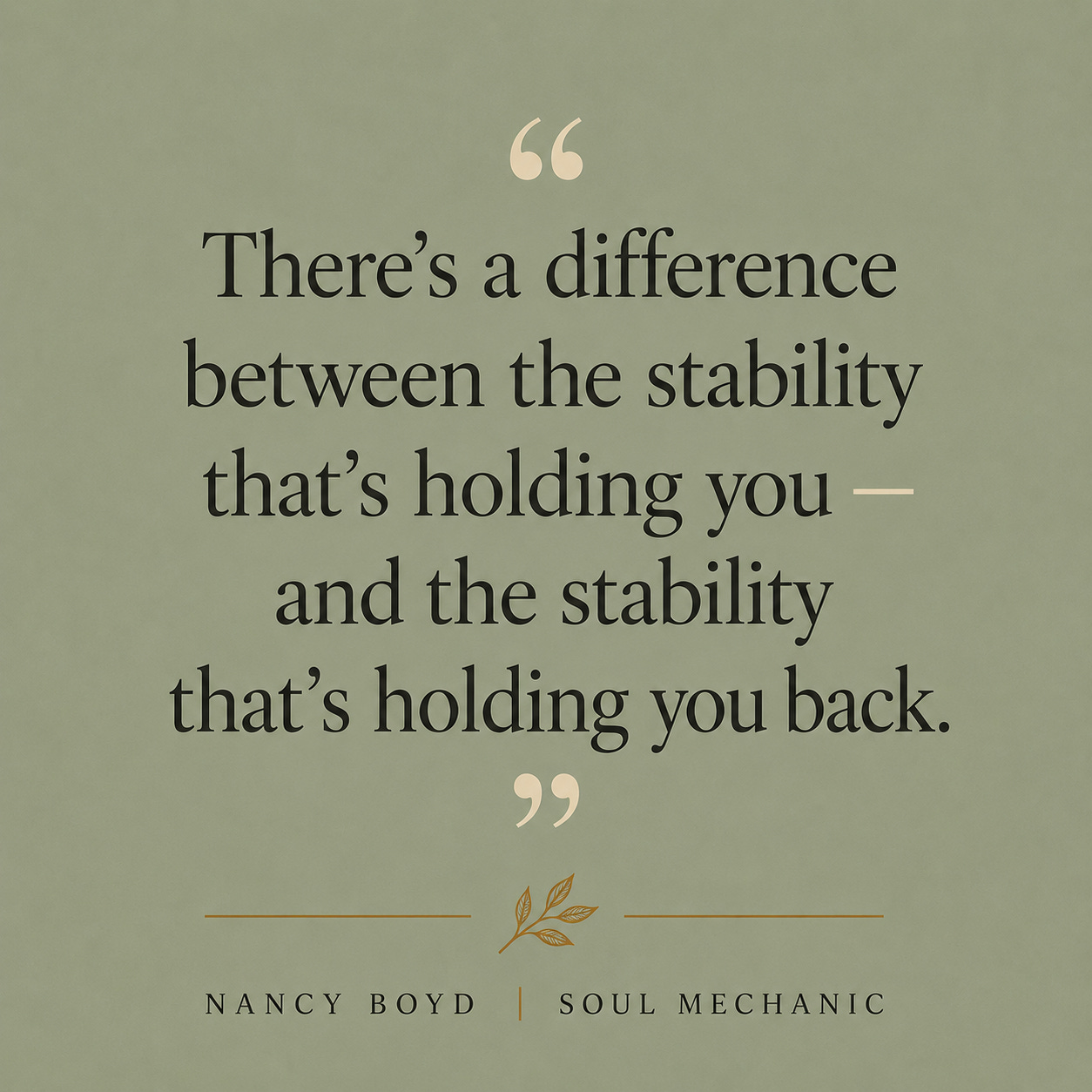
But you may have to look honestly at the difference between the stability that’s holding you — and the stability that’s holding you back.
If you’re not sure which one you’re in right now, that question itself is worth a conversation. Clarity, in this case, is a relief rather than a risk. → Check Your Soul Light Session
Want to understand how you’re specifically wired? Start here — free, 10 minutes: → Soul Type Assessment
← Part 8: The Problem With Being Good at Holding It Together
Next — Part 10: The Skill No One Taught Us — Reading Ourselves Clearly
Coming Back to Yourself is also becoming a book — with a preface, reflection questions for each chapter, and the complete series in one place. Coming soon to Amazon and major retailers. Paid subscribers get the Ebook version free.